
Here’s a question that comes up constantly, in salons, in comment sections and in web searches: is dip powder just acrylic powder with a different name?
The short answer is that they are close cousins, not twins. Both are finely milled polymer powders, and in many cases, the base chemistry is remarkably similar. The difference is not really the powder itself. It is the system built around it, how the powder gets onto your nail, what hardens it, and what that means for strength, finish and removal.
Once you understand that, the whole “dip vs acrylic” debate becomes much easier to navigate. So let’s break it down properly.
Chemically, they are very alike. Both dip powder and acrylic powder are made from acrylic polymers, typically polyethyl methacrylate or similar. If you looked at the two powders side by side in a pot, you would struggle to tell them apart.
The differences are in the details:
So no, dip powder is not simply acrylic powder in different packaging. But yes, they belong to the same family, which is exactly why the confusion exists.
Traditional acrylic is a two-part liquid and powder system. You dip your brush into liquid monomer, pick up a bead of acrylic powder, and the two react on contact. That bead is then sculpted onto the nail, where it self-cures into a hard, durable enhancement. No lamp needed.
This is the system that gives a nail tech complete control. You decide the bead ratio, the placement, the apex, the shape. It is how long sculpted sets, encapsulated designs and structured extensions are built. If you want to see it done step by step, I have walked through the whole process in my guide on how to use acrylic powder for salon-style acrylic nails.
The trade-off for all that control is skill. Working with liquid and powder takes practice, which is why it is the system professionals train hardest on.
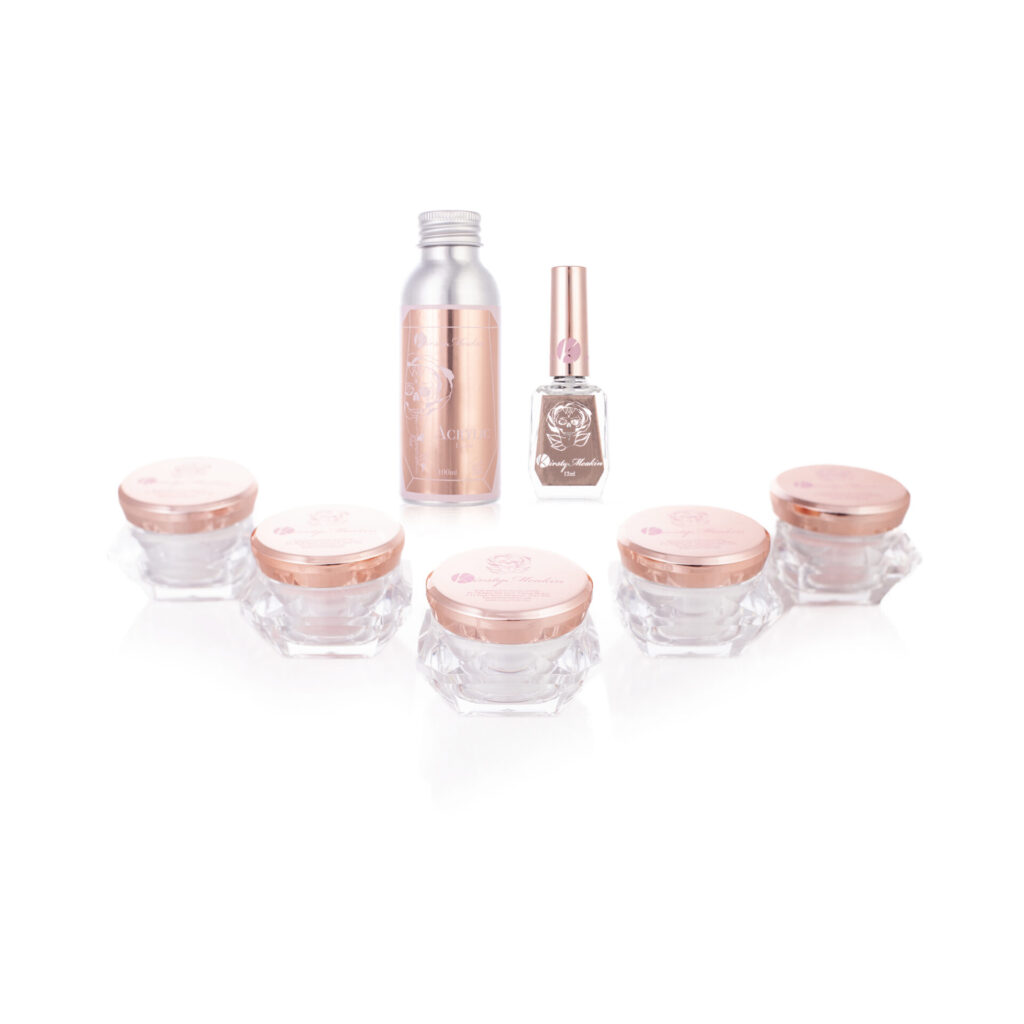
Dip powder flips the process. Instead of mixing powder with liquid on a brush, you apply a layer of resin to the nail, then dip the finger into the powder (or, more hygienically, pour the powder over the nail). The powder sticks to the resin; you brush off the excess and repeat for two or three coats. An activator then hardens the layers, and the nail is buffed and sealed.
There is no sculpting involved. Dip follows the shape of your natural nail or a pre-applied tip, building even layers rather than an architected structure. That makes it far more forgiving for beginners, and it is one of the reasons dip systems took off for home use.
One important note on hygiene: if you are having dip nails done in a salon, the powder should never be a communal pot that multiple clients dip their fingers into. Reputable techs pour powder over the nail or decant into a single-use portion.
Technically, yes. Because the chemistry is so similar, standard acrylic powder will bond to dipping resin. Plenty of techs use a coloured acrylic powder with a dip base when they want a shade that the dip range does not offer.
There are two caveats. First, traditional acrylic powder is milled coarser, so you may find the surface needs more buffing to get that glassy finish. Second, results vary between powders, so test on a tip before committing to a full set. If you want to experiment, a small pot of coloured acrylic powder from our acrylic collection is an easy way to trial it.
What you cannot do is run the swap in reverse and expect the same performance. Dip powder mixed with liquid monomer will react, but the fine milling changes how the bead behaves on the brush, and the workability suffers.
Strength. A properly applied liquid and powder acrylic is the strongest enhancement in the industry. It is the go-to for length, structure and durability. Dip nails are strong too, generally tougher than gel polish, but they sit closer to an overlay than a sculpted extension.
Wear time. Both systems comfortably last two to three weeks with correct prep. Lifting on either is almost always a preparation issue rather than a product issue, the same causes I cover in my post on why acrylic nails lift.
Removal. Both soak off in acetone, and this is where dip has a small advantage. The resin layers break down faster than a dense acrylic structure, so removal is usually quicker. Either way, the golden rule is identical: soak, never pick or peel.
It comes down to what you want from your nails and how you like to work.
Liquid and powder acrylic give you sculpting, length, encapsulation and total design freedom. It rewards practice, and if you are learning, a complete acrylic starter kit gives you everything to build that skill properly.
Dip offers speed and simplicity. It suits an even, natural-length manicure with minimal equipment, and there is no lamp and no monomer to manage.
Many techs use both, choosing the system to match the client and the look. Neither is “better” across the board; they are different tools for different jobs.
Is dip powder healthier than acrylic?
Not inherently. The polymer powders are similar, and nail health depends far more on correct application and removal than on which system you pick. Damage comes from over-filing, picking and poor prep, not from the powder itself.
Is dip powder just acrylic with glue?
That is a simplification, but not a wild one. The powder is closely related, and the resin is a cyanoacrylate, the same chemical family as nail adhesives. The difference is that dip resins and powders are formulated and milled to work as a matched system.
Does dip powder last longer than acrylic?
Generally no. Both last two to three weeks or more with good prep. Sculpted acrylic tends to hold up better on longer lengths because of its structure.
Do you need a UV lamp for either system?
No. Both acrylic and dip cure without a lamp, which sets them apart from gel systems. Acrylic cures through the monomer and powder reaction, dip through the resin and activator.
Can I use dip powder as an overlay for strength?
Yes, a dip overlay on natural nails is one of the most popular uses of the system, and it is a common alternative for people who want more durability than gel polish without extensions.
Want to go deeper on the liquid and powder system? Start with the complete acrylic powder guide, or browse the full range of colours and glitters in the acrylic collection.
Returns:
nails@kirstymeakin.com
Kirsty Meakin,
42 Winpenny road,
Park House Industrial Estate,
Newcastle Under Lyme,
ST57RH
